Showing posts with label History. Show all posts

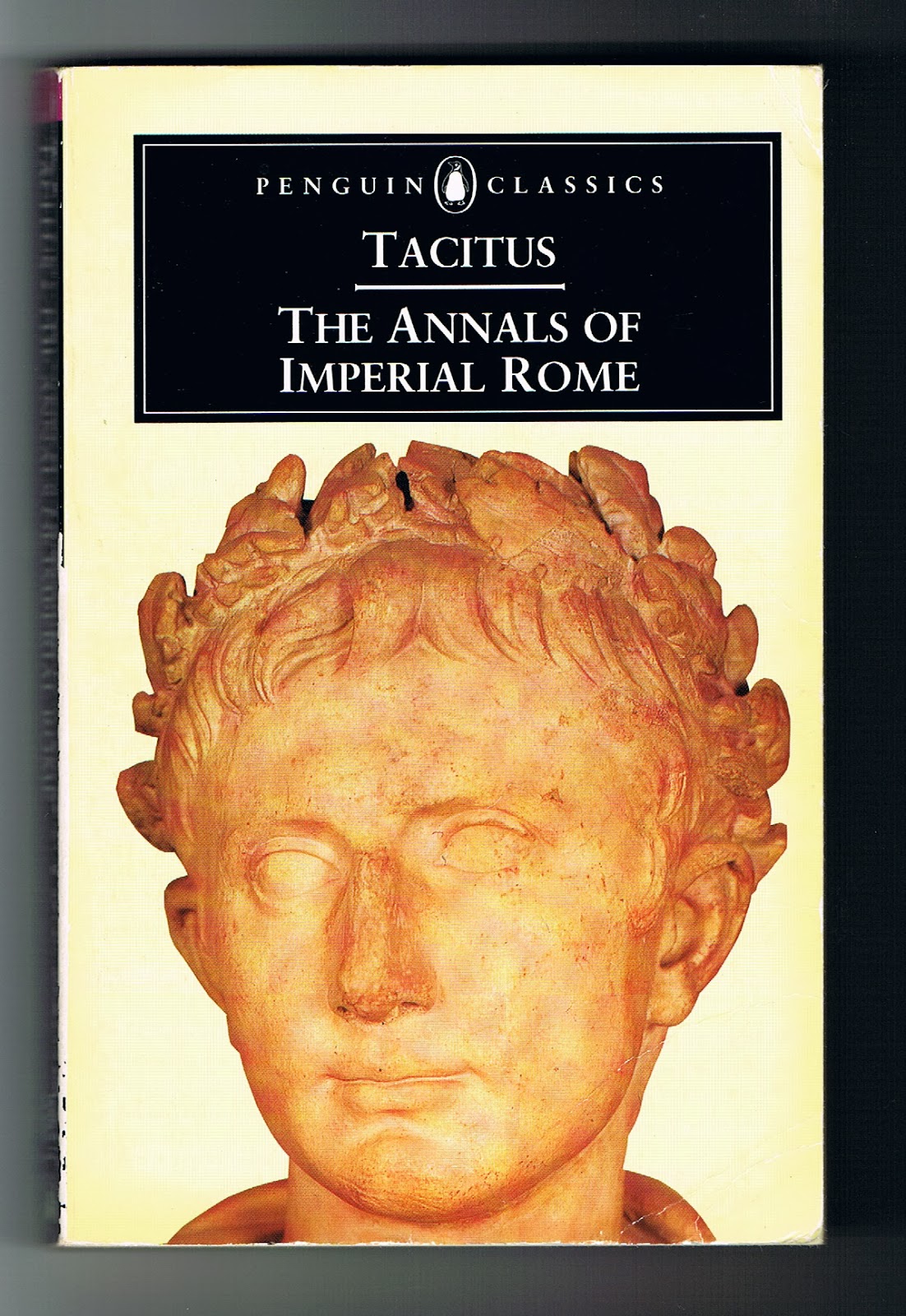
The Annals of Imperial Rome, by Tacitus, Reviewed.

on Sunday, October 20, 2013
There have been many translations of this classic; the one I read was the Penguin Classics edition, translated by Michael Grant. I came across the book, which I’d heard of but not previously read, whilst perusing the shelves of a wonderful little bookshop on the island of Santorini. (You’ll find Atlantis Books in Oia, should you ever visit the island). Hardly typical holiday reading, I nevertheless read most of the book whilst lounging beside the pool on a comfortable sunbed under a hot sun.

It’s generally the case that most of our leaders here in UK are educated in the classics. I can see why they hold the odd views they often do, if Tacitus is any guide to the content of their learning.

The book concentrates on certain aspects of Roman life that other historians have largely neglected, it seems. He is obsessed with legal cases, court actions and some fairly minor infringements of Roman law. Of course, there are accounts of battles, opinions on the various Emperors and tyrants (usually synonymous) who ruled the empire during the time he chronicles. First published around 102 AD, it deals with the short period from AD 14 to AD 68, when Christianity was in its infancy, but makes reference to many earlier historical events and personalities along the way.

The Annals reports on a period of history in which leadership was largely profoundly corrupt (a bit like the present, but with added casual execution, torture and murder – so perhaps not so different). Reflecting the beliefs of his day, he accepts the idea of mortal divinity whilst decrying the actions and morals of those made divine. He also believes in the existence of the legendary phoenix, so reliance on his belief system is probably unwise.

The book is dripping with the blood of the innocent mingled with that of the guilty. Suicide, murder, corruption, deceit, jealousy, nepotism, treachery, cheating, bribery, expedience, protection of those in office regardless of worth or merit, destruction of evidence, official blindness, flattery, preferential treatment, torture of lower classes to support claims of upper classes, incredible courage and noble sacrifice are all described. The reader is filled with a sense of how frightening it must have been to live in Rome and its empire of the time.

The absence of instant communication over great distance in an extensive empire that allowed distortions of truth and downright lies, shows how rumour could cause instant death, followed by regret when truth caught up with those guilty of the injustices.
If you have ever wondered how some leaders of the modern world can behave in the way that they do, this book gives an understanding of the minds of rulers and those who support them. I’m glad I read it, but, if you have children, I’d advise you to keep the text away from them until they’re mature enough to sift the right from the wrong, the good from the bad, the truth from the speculation and assumption. A fascinating but uncomfortable read and a real insight into the way in which power corrupts and absolute power corrupts absolutely. Recommended.
Enhanced by Zemanta

Lakeland to Lindisfarne, by John Gillham, Reviewed.

on Sunday, February 24, 2013

Walker, moutaineer, historian, or just interested in the great outdoors? This book has something for you. It was a Christmas present from one of my wife’s sisters, some years ago, and has been sitting on the shelf until now. I picked it up as a light alternative to the rather disturbing piece of fiction I finished last week. And I’m so glad I did.

This guide is intended as just that; an introduction to and a planning tool for a coast to coast walk from the west to east shores of northern England. John Gillham makes it clear from the start that you need to procure more detailed maps than the illustrative drawings he supplies alongside the text, if you are to complete this varied ramble through some of our finest landscapes.

There are mountains, vales, rivers and moors to cross on this varied route. And Gillham brings them all to life, adding small panels of local history where applicable. The reader learns some fascinating facts along the way, and is entertained with rural humour. He gives tips about various villages, pubs, bothies and ancient monuments. He also provides alternative routes, catering for the less experienced walker as well as the proper mountaineers.

For me, this was a trip back to a pleasant past. The walk starts in the Lake District, where my wife and I spent our honeymoon, and brought back many happy memories of those days. The middle section takes the reader through an area of England not much visited and one that I do not yet know. But the last part of the walk, as it approaches the north eastern coast, involves a walk through Hexham where, before we were married, we were mistaken for hotel inspectors at the hostelry we’d chosen for our meeting. Needless to say, the service and food were excellent on that occasion! The route passes Rothbury, where we dined together at another time in our early relationship. Unfortunately, on that occasion, I contracted food poisoning that resulted in the most horrendous drive back down to the Essex town where I then lived. It passes through Clennel Street, close by Clennel Hall, where we stayed very early in our relationship and confirmed that we would spend the rest of our lives together. So, another pleasant reminder. And, in fact, as a result of reading the book, we’re now intending to do some parts of the walk.

I’m well past the days when I can contemplate tackling such an arduous walk as a complete exercise, but, because John Gillham breaks it up into smaller parts, we’ll definitely be hiking several parts of it over the coming years. And I give my thanks to him for mapping out this route through some of the most spectacular and beautiful scenery in this small island of ours.

The photographs that illustrate the walk are all excellent; some merely informative, but many reflecting the beauty of the landscape and giving a clear idea of what the walker can expect to see along the way. I look forward to visiting these places with my wife and my camera in the near future.

The final part of the book is a diary, kept by John’s new wife, Nicola. This is a charming, personal account of her trip with him as he mapped out the routes he suggests. It gives a touching insight into the loving relationship between the couple and provides a more intimate view of both the pleasures and hardships that the walker may encounter along the way. I enjoyed this short piece every bit as much as the main narrative.
So, whether you’re a seasoned walker, a sometime rambler, or one of those tourists who rarely moves more than a few paces from your car, there’s something in this book for you. I picked it up as a contrast to the gritty and disturbing fiction of urban poverty that I’d read previously. As an antidote, it was perfect, and I thoroughly recommend it.

Enhanced by Zemanta

Play With a Tiger, By Doris Lessing, Reviewed.

on Saturday, January 19, 2013

One thing that can be said with little fear of contradiction is that Doris Lessing's work is anything but simple and straightforward. She loves to wrap her characters and plots in multiple layers, through which the reader must pick his way, often with only minimal guidance as to direction and even, sometimes, intent.

Play With A Tiger was first performed at the Comedy Theatre, London, on 22nd March 1964 and is set in the city. Whilst it's very much a play of its time, it nevertheless carries some of its themes fairly well into the modern day. Attitudes to unmarried mothers have changed for many, political normality has become anything but, and extramarital affairs are now so commonplace as to be almost expected, but the war of the sexes continues, for some, at any rate.

As Anna and Dave reconstruct their pasts and possible futures, their dialogue exposes their sometimes opposing, sometimes similar stances. The descriptive passages that take them back in time explore their development as people and depict the lives of their parents and families in ways that explain, to some extent, the way they are now. But there is an underlying tone of self-absorption and mutual distrust that was, as I recall, a very common situation for men and women at the time. I'm not convinced it is any better now than it was then, but the development of family planning aids has definitely made things different for the single woman in search of love without the wish to raise a family. This aspect of the relationship between men and women is so different now that modern audiences may have difficulty understanding the dilemma facing maturing women back in those early days of burgeoning sexual freedom.

Dave is careless and unaware of the reality of the effect of his philandering on the women he seduces and uses as an excuse to bolster his ego. He's not a character I can find much sympathy for, with his utterly selfish concerns. Anna is singularly confused and seems unable to make up her own mind about much that troubles her in life. She yearns to be as free as she believes Dave to be, and it's easy to understand this desire when set against the strictures society places on her.

There are asides, set-based devices, and other interactions that illustrate the differences between the male and female views of life at the time, and I suspect these would have worked very well in performance.  They don't translate well via the text alone, however. Would I go to see the play in performance?  I wish I'd seen it at the time, when so much more was immediately relevant, but I don't think I'd watch it today, unless it was substantially re-written to accommodate what has changed. For all that, I enjoyed the read.

Enhanced by Zemanta

Ross, by Terence Rattigan, Reviewed.

on Monday, January 14, 2013

First performed at the Haymarket Theatre in London, on 12thMay 1960, this dramatic depiction of the life of T.E Lawrence, Lawrence of Arabia, uses insight, perception and historical events in an attempt to convey something of the reality of this enigmatic man. Of course, most readers will have seen or at least heard of the slightly later David Lean film, Lawrence of Arabia, written by Robert Bolt and Michael Wilson and employing Lawrence’s own writings. The two productions are very different, of course.

Rattigan employs backstory, setting the play initially on the RAF camp where Lawrence, in his other persona, Aircraftsman Ross, attempts to escape his past. After some illustrations of the banality and pointlessness of a service life I recognise from my own short days in the RAF, we are taken into those now famous events that both made and destroyed the man we all know as Lawrence of Arabia. Using dialogue and character to explain this complex figure, Rattigan is able to get at least partially beneath the skin of his protagonist. What he also manages to achieve is the exposure of the prejudices of the times, the blinkered attitude of the military, which appears to continue to this day, and the necessary duplicity that prevails amongst those senior figures during war. But what he reveals, more than anything else, is the sheer, brutal indifference of violent conflict. On the page, the horror and torment are palpable: in performance this must have been so very difficult to watch. Yet, I imagine that audiences were so captivated by the personal will of the lead character that they were unable to escape the performance.

Rattigan has brought to life a man who has defied explanation, a man both reviled and loved, hated and worshipped, honoured and despised, during his lifetime. But he has also tried, with some success, to explain the way in which exposure to different cultures and values, different sacred creeds, colours so absolutely the outlook of those who live within their influence.

This play is much more than a biography of a remarkable man; it is a statement about hypocrisy, the expedience necessitated by war, greed, betrayal, loyalty, friendship and love. A truly remarkable piece of theatre, even when read only on the page. Were this to be recreated as a stage performance, I would do all in my power to attend. If the power is so great in the text alone, performance must render this work one of the most outstanding theatre experiences. Thoroughly recommended. Read it.

Enhanced by Zemanta

Five Finger Exercise, a Play by Peter Shaffer, Reviewed

on Saturday, October 27, 2012

First performed in 1958, this is a play of its time. I’m not sure the modern generation would understand the subtleties of the upper middle class family and its seething social and class tensions. The addition of the German tutor as a fulcrum for change, so short a time after the war, would nowadays not have the power and relevance it must have had for an audience of the day. Of course, those of my own generation, and earlier, would appreciate these factors, but whether the play could be enjoyed by a younger audience is open to debate.

In the written text, there’s an ambiguity surrounding the relationship between the tutor and the son that could hint at homosexuality. But the resolution of this in performance would be dependent on the actors playing those parts and the direction they were given, and I’m still unable to decide whether their attempt at friendship is platonic or subconsciously sexual.

Employing a girl developing into early womanhood as the object of the young tutor’s teaching, enclosed, as they are, in a tight and intimate setting, would now be seen through different eyes. In fifties England, paedophilia was a taboo subject and one not considered for public exposure or discussion as it now is. Again, the playwright may have had ulterior motives and may have been adding a layer of complexity to the plot by suggesting a sexual longing on behalf of the daughter. Certainly she develops a crush on her tutor, and this, once perceived by the mother, is a cause for the older woman’s jealousy, since she also fancies herself in love with the young man. But the crush may have been intended as no more than the sort of puppy love displayed by young girls for objects of devotion, without the sexual connotation it would inevitably acquire for today’s audience.

The relationship between the businessman father and the social climbing mother with artistic pretentions is almost clichéd, though here it is rescued from that fate by making the woman of French origin. The tensions formed by her sensitivity and his pragmatism, especially as these pertain to the raising of the son, are classic in their portrayal. The fight about his education at university, studying English Literature, instead of taking the route of practical apprenticeship in his father’s furniture business, is so well drawn that it may well be based on the author’s own experience. I don’t know whether that’s the case, however. This sort of conflict, where the mother wants her son raised to appreciate the finer things in life and the father wants him to be moulded into his own image in order to carry on the business, is a fairly common element of fiction and drama or the era.

This is a play about class war, the then prevalent theme of the war between the sexes, prejudice regarding nationality, and the ever-present conflict between those who make money and those who merely spend it. Whether it would work for a contemporary audience I couldn’t say. Certainly, however, if it were to be performed locally, I’d attend. As a study of the times, this is an excellent example of drama, and, given the pedigree of the creator, is as   well written as you’d expect. I enjoyed it.

Enhanced by Zemanta

Ancient Symbol Worship, by Westropp & Wake, Reviewed.

on Monday, April 23, 2012

This is a modern version, not the one I read,
and may contain more information.
Subtitled, Influence of the Phallic Idea in the Religions of Antiquity, this book came my way as one of a small collection given me by my brother when he was sorting stuff out prior to a move to a new house with less space. He used to work in a book store and has a number of fairly unusual titles in his library. This was one he hadn't got round to reading, but the title and subtitle intrigued me.
This small volume, first published in 1875, sets out to examine the influence of the phallic, or male, component in ancient religion. But it takes this idea into modern religion, suggesting that the ancient beliefs, customs and rites have been absorbed and altered by modern celebrants in forms recognisable to those who wish to see.
There's some Latin, untranslated, and a colossal amount of reference to often obscure issues that were, presumably, well known to scholars of the time. But, for a modern reader, these references remain unexplained and would require a great deal of research to track down and more time than most people have these days for such esoteric issues. Whilst those who already have a deep interest in the symbolism employed in worship will undoubtedly understand the references, the rest of us will remain confused. However, much is clarified by context and, having an interest in many subjects, I was able to apprehend a lot of what the authors allude to, though other items consisted of listings of arcane information lacking any hook on which I could hang it.
That the book was written in the Victorian era, with its dreadful hypocrisy regarding all matters sexual, shows in the circumspection that rules the writing. Where, today, we would name the penis, testes, vulva and breasts without fear or embarrassment, the authors are constrained by the customs of their times and therefore have to express much of their ides in convoluted form or by the use of metaphor, much of which is couched in classical references that will be lost on many modern readers.
A second factor in preventing the authors expressing themselves frankly and with clarity is their sensitivity to the feelings of those who profess a faith. Again, today, such sensitivities can be dealt with more openly, showing respect rather than reverence. In the time the book was published however, such frankness, leading to real clarity, would have probably prevented publication.
So, an already difficult subject is made more obscure for reasons that are no longer valid. As the ideas and information explored are still valid and in need of wider publicity, I'd love to see some modern scholar produce a similar volume for today's reader with a much clearer text. Perhaps it's been done and I simply haven't come across the book.
As it is, this book can really only be read by the general reader as a partial glimpse into the subject. Those with a good knowledge of ancient history, religion and symbolism will glean a good deal more, however. Many of the ideas expressed as certainties have, of course, been placed in doubt or even refuted by more recent discoveries of texts from such sources as the Dead Sea Scrolls and other ancient records and parchments retrieved from many different sources by modern archaeologists.
Members of religious organisations will no doubt be outraged by suggestions that the roots of their current dogma and rites grew from ancient forms of worship that were definitely based in reproduction and sexuality, often in very explicit acts of devotion, sacrifice and propitiation to the early deities. But a dispassionate and disinterested examination of the rites, customs and beliefs of such groups quickly establishes their ancient links with many practices and myths no longer considered either right or sensible.
A demanding read, not for the faint-hearted.

Enhanced by Zemanta

As it Seemed to Me, by John Cole, Reviewed.

on Sunday, April 8, 2012

This political memoir examines the journalist's thirty-odd years in the trade. It covers a period through which I lived, not quite contemporaneously with the author, who's senior to me by twenty years. Nevertheless, I watched his television reports through the period and, in reading this work, I could again hear the tortured vowels of his Ulster accent.

I always admired the man as a political commentator and reading the book only serves to increase that admiration for someone for whom honesty and pragmatic realism were clearly guiding principles. His neutrality continues, as it did during his long and illustrious career in a field for which he was truly fitted. Moving from his native Northern Ireland to England early in his working life, he served on such august bodies as the Guardian, the Observer and, of course, the BBC in various roles from reporter to editor, ending up as the senior political commentator for that broadcaster.

The book is written very much from the point of view of the observer of political life and there are places where the author's assumption of the reader's knowledge and interest in some of the minutiae is taken for granted. I never reached that level of absorption at the time and so certain passages became less clear to me and there were a number I skipped completely. But there are over 400 pages of dense prose here, so some skipping is, perhaps, excusable.

John Cole's delivery is clearly that of the experienced and professional journalist, with never a word wasted. He packs a great deal into each sentence and the writing can hardly be faulted for its presentation of a complex period of British history.

That I find myself in sympathy with his misgivings about many events and the attitudes of some politicians, particularly the imperious and overbearing Margaret Thatcher, obviously makes me more sympathetic to what he has to say. It's encouraging to know that my impression of our first female Prime Minister as an inflexible martinet with fixed ideas based on ideology rather than pragmatic reality is reinforced by this man who lived close to the action.

This is a book I read initially because it was on my shelves and I'd promised myself I'd read all such volumes before I bought any more. I can't recall how I came by it. Probably, it was one of a package offered by one of the many book clubs I've belonged to during my lengthy reading career. I'm sure I didn't buy it as a separate and targeted book at the time. But I'm glad I've given it the time it deserves, even if somewhat belatedly (it was published in 1995).

It's reinforced some of my impressions of the period, repudiated others, educated me about many and filled in gaps I hadn't realised existed in my knowledge of the time I lived through.

For any reader whose idea of a good book is restricted to the fantasies of fiction, there's nothing here for you. But for those interested in recent British history, the shenanigans of politicians or the profession of journalism, this is a damn good read and I recommend it to you.

Stuart's Daily Word Spot (Antonyms): Nab/Release

on Sunday, December 18, 2011
Female members of the Wehrmacht are among the ...
Image via Wikipedia

Nab/Release

Nab: verb - catch and take someone into custody; apprehend, arrest; snatch or seize something; steal.

Release: verb - liberate; free from physical restraint or imprisonment; let go of.

'Noreen left her place in the check-out queue to step outside and nab the man she'd watched steal a can of Coke from the supermarket shelves.'

'Keep an eye out for the barman, whilst I nab some beer from the pump.'

'When the allies marched into the town, they were able to release the prisoners of war who'd been held in camps for so long.'

'I want you to release that cash into my custody, where I'll make damned good use of it.'

1621 - the English parliament unanimously accepted Protestation, and the roots for conflict were formally planted. In parts of the UK that conflict remains and provides certain ill-informed fools with a motive for indiscriminate killing.

1960 - A General Meeting of the UN condemned apartheid. In backward parts of the world, such prejudice remains, allowing the ignorant and afraid to blame all misfortune on those who fail to appear to be like them.

Enhanced by Zemanta