Showing posts with label Yorkshire Dales. Show all posts

September and October Combined Results

on Saturday, November 2, 2013
The usual monthly progress report covers 2 months this time. We had reason to celebrate and decided
to do so in style, since it’ll be the last for a long while. The silver wedding combined with my retirement from employment and ability to work full time as a writer called for a special break. That occurred across the 2 months, starting toward the end of September and ending in the second week of October. Added to that was a short break we took to visit my brother and his wife in the Yorkshire Dales. So a somewhat interrupted work period.

Of course, the fact that I had to stop writing the fantasy for a while meant I needed to re-read what I’d already written on our return from Santorini, before I could continue with it. I completed that re-read just in time for the month end, which is just as well, as I’m taking part in NaNoWriMo this year and using it as a deeper motivation to finish the fantasy book. (See post below, if you’re interested).

On holiday, I’d intended to read quite a lot, but the company, surroundings, events we took part in and the need for rest in between meant I didn’t read quite as much as expected. Nevertheless, I did read a few books, and reviewed them on my return. I also reviewed on Tripadvisor all the places we’d visited whilst on holiday.

So, the chart gives an indication but is not as reliable or accurate as usual. Make of it what you will.
November will be dedicated to the writing of the final book in the trilogy and I’ve already written 5,700 words over yesterday and this morning. I’m aiming at 3,500 words a day, so a few more to do after I’ve posted this piece.

Once again, let us all know how you’re progressing with your writing. It’s easy to place a comment here, after all.

The chart, explained:
Writing - initial creation of stories, blog posts, reviews and longer works.
Editing - polishing of all written work to make it suitable for readers.
Research - discovery of info for story content, market research, contests and blog posts.
Reading - books and writing magazines.
Networking - emails, Twitter, Pinterest, Facebook, LinkedIn, Google+, and comments.

Admin - story submission, blog posting, marketing, organisation, tax, and general admin tasks.
Enhanced by Zemanta

The End of an Old Life and the Start of a New One.

on Tuesday, April 2, 2013

I write this in the new role of full time writer. Officially, my retirement starts on 5th April and my 65th birthday isn't until next month. But, for reasons I won’t bore you with, I finished employment on 21st March. Last week was supposed to be a holiday, to ease the passage from one stage to another. However, outside events intervened and I spent some of that in hospital and much of the time since in recovery. The knee’s progressing well and I’m now able to walk unaided for short distances.

It’s been a mixed month: emotionally demanding. In spite of the fact that I was eager to finish my time as an employee, the conditioning we receive from society confers the role of breadwinner on most men and entrenches that expectation, so I experienced some muddled emotions. The turmoil was short-lived. I shall continue to be the provider, but using pensions instead of wages. And, now I have the freedom, my writing will contribute to my earnings more than it has.

What was intended to be a short period of relaxation, to allow me to settle into retirement, turned out to be a physically demanding period in the hands of skilled and caring medics. I chose to have the operation under local anaesthetic, as previous experience with general anaesthetics has caused violent vomiting; something I prefer to avoid. Also, being able to witness the procedure allowed me to collect further experiences for my writing.

English: Right knee.
English: Right knee. (Photo credit: Wikipedia)
I managed to give the anaesthetist a bit of a problem. My blood pressure was textbook but my pulse rate rather slow (much to my pleasure, he compared it to that of an athlete). The spinal anaesthetic has the effect of fooling the heart into believing that the lower half of the body has lost interest in receiving blood, so the pump slows down. In my case, rather too much, so that I began to faint. Oxygen and an injection of some stimulant soon had me performing normally again. For associated reasons, however, I began to shiver with cold as my core temperature dropped a couple of degrees in the air-conditioned theatre. That was readily cured by the use of an inflatable blanket attached to its own supply of hot air (something I can generally provide without difficulty). I was kept wonderfully warm throughout.

The most surreal aspect of the experience was seeing the surgeon lift a leg that was mine, but appeared to belong to someone else, so convinced was my body and brain that it remained flat on the table. Extraordinary!

The offending intruder in the joint (matchstick for scale)
Watching the images from the camera as it toured my knee joint was fascinating. The obstruction, a piece of bone about the size and shape of an unshelled almond, was located fairly early in the procedure. But the normal route of extraction turned out to be unsuitable, so a third incision was made to give better access and, after 40 minutes on the slab, the offending invader was removed. The surgeon showed me the hole, at the rear of the patella, where the piece of bone had once resided, evident even 19 years after the incident that caused the injury. He cleaned up the rough and damaged surfaces of the cartilage within the joint and on the back surface of the knee cap, flushed out the other small bits of detritus, and sewed up the wounds.

Once out of the recovery suite, I was wheeled back to my private room (this is the NHS so such luxury is a treat) and fitted with a surgical stocking to match the one on my ‘good’ leg. These help prevent the dreaded deep vein thrombosis that can afflict older patients, especially following surgery on the legs. As an added precaution, I was provided with five pre-packed injections of anti-coagulant and shown how to inject the first of these into my stomach so I could do the rest over the following days.

The medical aspects done, I had to drink (something I was very ready to do), eat, and pass urine before I could be released. By late afternoon I was free for my wife to take me home. The anaesthetic began to wear off during the journey and I understood I was in for a period of pain, of course.

Subsequent days have seen me hobbling and then walking with the aid of my father’s old walking stick. Yesterday, I managed about 1 mile, so I’m clearly well on the road to full recovery. Now looking forward to longer walks in the wonderful Yorkshire Dalesand bike rides around the local countryside.

You’ll understand that the month hasn’t been what could be called a ‘regular’ period of time, especially as the Easter holiday intervened. I’ve also begun the touch-typing lessons I alluded to in a previous post. So far, I can manage asdfghjkl; and am now starting on t and y. I’ve discovered I have to do the exercises in short bursts as my fingers ache at present. This, of course, will reduce as I become used to the movement. One other thing I’ve noticed is how sensitive the keys are. Last time I tried touch-typing it was on a manual typewriter and required considerable force to move the keys. Different technique required. But it’ll be worth the effort and time to increase my 2 finger, 1 thumb speed above its current 45 wpm. And, of course, I’ll be able to copy type, without looking at the keyboard as I do now.

At last, then, to the chart. You’ll note that a significant part of the month has been spent reading, which is hardly surprising, given the above. I managed some writing: reviews, blog posts and a short story. Did some editing; the epic fantasy, short stories, blog posts etc. A great deal of internet research, largely in preparation for the future, and much work done under the catch-all label of ‘Admin’, which includes the typing lessons and the conversion of some textual quotes into tweets. The contests page has been updated a couple of times, and that’s always time consuming. Needs doing again, of course. But I failed utterly in the submissions department. Not a single story sent to either contest or magazine. I intend to correct those omissions in the coming weeks. And, of course, I’ll be doing more real writing from now. That, of course, is the exciting stuff.

A longer piece than envisaged when I began, but I thought my experience might help those who face similar interventions. I hope so, anyway.

How did you do during this third month of the year? Hit your targets, increased your output, experienced anything new? Let us know and share it with us here.

The pie chart, explained:
'Writing' - initial creation of stories, blog posts, reviews and longer works.
'Editing' - polishing of all written work to make it suitable for readers.
'Research' - discovery of info for story content, market research, contests and blog posts.
'Reading' - books and writing magazines.
'Networking' - emails, Twitter, Pinterest, Facebook and Google+ activity.
'Admin' - story submission, blog posting, marketing, organisation and general admin tasks.

Enhanced by Zemanta

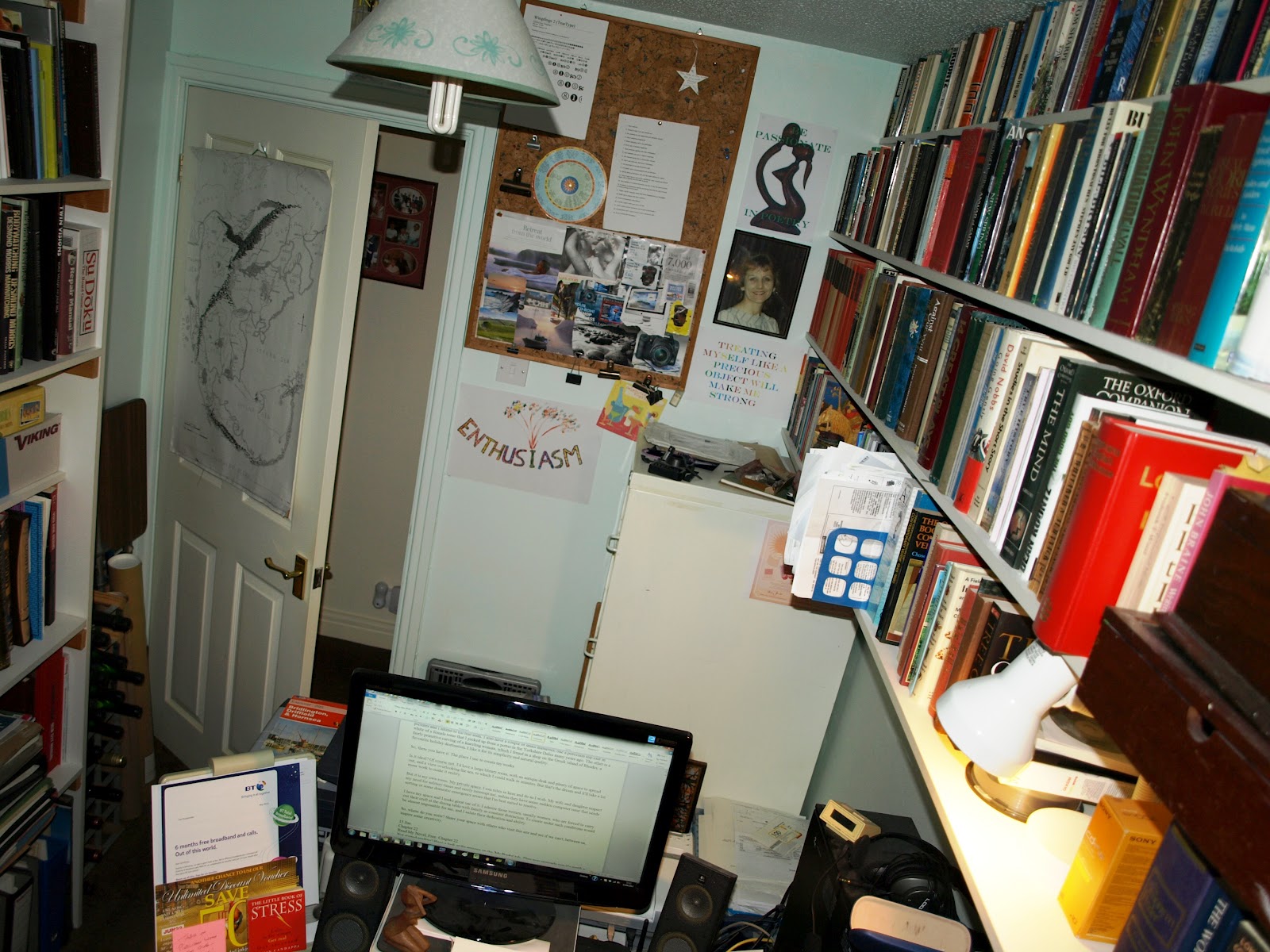
The Writing Den; What's Yours?

on Thursday, June 14, 2012

Whether luck or prudence provided me with a room of my own is for others to determine. My suspicion is that, in common with most things in life, it's a mixture of these things. Be that as it may, I have the good fortune to have a room in which I can lock myself away from other concerns when I write.

It's not ideal. Small, with a window, behind me, that overlooks the end of the drive with the fence between us and the neighbours beyond and the garage door to the right. As I sit, at a desk built from a flat-pack kit bought some twenty or so years ago, I face the door into the hallway of our bungalow. At present, because I'm writing this before my wife and daughter have emerged from sleep, I have that door closed. Hanging from a hook on the back is a hand drawn map of the land I'm using to set my epic fantasy. Beside that, a cork board bears a few documents as aids in my everyday writing as well as a collage I made as part of the creative aspect of Julia Cameron's The Artist's Way course I'm currently undertaking. It depicts those things I most want in life and is intended as both motivator and reminder of why I do this thing; writing. Next to that is a portrait of my wife and a couple of self-designed posters to act as reminders about certain of my less positive aspects - positive statements to keep me on track.

A large, four drawer cabinet sits below these, housing an assortment of things that have nothing to do with my writing; it lives here as the only suitable location for such a metal monstrosity. Utilitarian but exceedingly useful.

Directly in front of the desk a small chest of drawers stores various bits and pieces and acts as base for my printers. Printers? Yes. A monochrome multifunction laser printer for my physical submissions; it gives the best quality text. And a colour inkjet for my drafts and to print off those things that need to be in colour, including photographs.

My desk holds the computer, which actually sits on the desk as there's no room on the floor, where my feet rest on a plastic footrest. A pair of headphones sits on top of the computer box, for those times I want to exclude all external noise, playing the music I have recorded onto the system. My flat screen monitor is directly ahead, on one of those rotating stands that allows it to be moved out of the way. The speakers sit either side and the mouse, along with a graphics pad rest to my right. The box of gubbins that projects the internet signal to my wife and daughter's computers also lurks there, under the monitor. A document stand rises with various bits of essential paperwork to the left and a coaster holds a glass of water (I never drink alcohol in here, though wine is stored in a rack just behind the door.)

I have pens, pads and post-it notes at hand either behind me on the windowsill or on the desk itself. The drawers to my right hold all the essential stationery and other stuff I might need.

The walls on either side are lined from floor to ceiling with shelves bearing most of my books. My essential reference volumes are within easy reach for all those occasions I need to consult an oracle.

I play music as I write. Not because I listen to it, but because it excludes those external sounds that might otherwise distract me. I have two playlists. One mostly of popular music and giving 2 days of tunes if played constantly. The other contains classical music and would last for a day and a half if played without stopping. I play them alternately and use the random selection option so I never know what track is coming next.

A radiator at my back keeps me warm in winter and the window above it can be opened for fresh air and cooling breezes in summer.

There is little decoration, largely because there's very little spare wall space. But there's room for a few pictures and I intend to fill that soon. I also have a couple of small statuettes; one a porcelain slip cast in white of a female torso that I picked up from a potter in the Yorkshire Dales many years ago. The other is a fairly primitive carving of a kneeling woman, which I found in a shop on the Greek island of Rhodes, a favourite holiday destination. I like it for its simplicity and natural quality.

So, there you have it. The place I use to create my works.

Is it ideal? Of course not. I'd love a large library room, with an antique desk and plenty of space to spread out, and a view overlooking the sea, to which I could walk in minutes. But that's the dream and it'll take a lot more work to make it reality.

But it is my own room. My private space. I can relax in here and do as I wish. My wife and daughter respect my need for solitary times and rarely interrupt me, unless they have some sudden computer issue that needs sorting or some domestic emergency arises that I'm best suited to resolve.

I have my space and I make great use of it. I admire those writers, usually women, who are forced to carry out their craft at the dining table with family as constant distraction. To create under such conditions would be almost impossible for me, and I salute their dedication and ability.

So, where do you write? Share your space with others who visit this site and see if we can't, between us, inspire some creativity.  

Enhanced by Zemanta

Why I Set my Novel in the Yorkshire Dales.

on Thursday, March 29, 2012

Writers choose locations for their fiction for all manner of reasons. Sometimes it's because the place is a familiar haunt. Sometimes the setting is exactly right for the fabric of the story. Sometimes the landscape is so alien to the author that it stimulates his imagination.

I grew up in Yorkshire and it has been my home for much of my adult life, though by no means all of it. Many years ago, when I was married to my first wife, in fact, (and I've been married to my current lovely lady for coming up to 24 years) we were walking in a particularly remote and rugged part of the Yorkshire Dales. There are some sink holes in this area. For those who don't know, these are geological features that are best described as vertical caves. Often quite deep, usually narrow, they are places where water has eaten away the porous rock and left a deep pit in the surface of the Earth. The Buttertubs, as this particular set of sink holes is known, are a series of pits close to the narrow and precipitous road that leads from Hawes to Muker. Readily accessible, they are a tourist attraction for many motorists but few walkers.

It was a chill and windy day when I approached these holes in the ground, grey clouds skimmed a pale sun, and the gusty wind made waves through the long grass. At that time, the pits were unfenced and entirely open to public gaze with none of the modern obsessive concern for 'health and safety' rules. It was possible to step right up to and, indeed, over, the edges of these shafts. I am uncomfortable with heights and, since I was determined to gaze into the bottom of the largest and deepest, I sank to my knees and crawled forward until I could safely peer into the dim depths. As I did so, quite inexplicably, I was visited by a brief image of a woman's body at the bottom and the question was posed in my writer's mind, 'What would you do if you found a dead body down there?'

That thought stayed with me over the years. A divorce and remarriage took me to different parts of the country and overseas for the first time. But I was drawn again and again to the Yorkshire Dales until, almost on a whim, my wife and I with our new daughter just 2 years old, moved into the area to live. Our walks became regular events, regardless of weather. We experienced everything from dry thirsty heatwaves to icy winters cloaked in deep drifting snow and everything in between, as can only happen in good old island Britain.

It was whilst we lived in this location that the initial question slowly coalesced into a plot, peopled by the characters I had long lived with in my imagination. The story developed and the setting became part of the narrative, as much a character in the tale as Faith or Leigh, in fact. It was the natural setting for the rugged and tough tale and the fact that I was living in it made the descriptions so much easier. So, the first draft was completed at the same time as I renovated the house we'd bought and worked part time for a local holiday accommodation company.

Life came along, in the form of redundancy, just days before the new millennium was about to commence. At the age of 51, I understood my chances of re-employment in the area were slim and I moved the family back to my native East Yorkshire, where I found a job. It was some years before I found time to write again and dug out that first draft. I changed the viewpoint characters, giving both the male and female protagonists a chance to have their say in first person. I changed relationships that formed essential background to the story. I changed incidents. I changed the ages of the protagonists. What I didn't change was the setting. The Yorkshire Dales remained as valid a landscape as it had been from the beginning.

For those who don't know the area, it is a National Park. An area of outstanding natural beauty and considered by many to be the best walking country in Europe. It's populated by a native people who are as tough as the characteristic dry stone walls, as stubborn as the local sheep, as different as individuals as are the inhabitants of any region.

I changed the time frame to a period that was historically real: the severe drought of 1976, since the weather and the burgeoning philosophy of 'free love' allowed me to introduce a degree of external nudity that would otherwise be unlikely in this wild country. The nudity was an essential element in the relationship of the two protagonists and a useful tool in examining the fight between innocence and corruption that is at the heart of the story.

So, there you have it. Those are the reasons I came to set my romantic thriller, Breaking Faith, in one of the most beautiful parts of the English countryside. Many readers have commented on how apt the setting is. Whether you'll agree or not can only be determined by reading the book. And I give you the opportunity to do that for free here on this blog. Each week of this year I am posting a chapter. There are 50 in all, so it'll last for almost the whole year. And each post is accompanied by one of my photographs taken in the Dales, so you can experience the landscape for yourself. I started in January and the link to that first instalment is here. You'll find the rest of the early chapters listed in the archive and you're welcome to join the readers as we take the journey together to the end.

Enhanced by Zemanta